

Preface
Screws are one of the most common fasteners used in construction, manufacturing, metal fabrication, furniture assembly, electronics, machinery, automotive components, and DIY applications. Although they may look simple, choosing the wrong screw can cause loose joints, stripped threads, corrosion, weak fastening, or product failure.
A good screw selection process should consider material, thread type, head style, length, surface treatment, load requirement, installation method, and operating environment. Industrial buyers should also consider quality standards, production consistency, mechanical strength, and supplier reliability.
In many applications, screws are treated like small low-cost parts, but their role is much bigger than their size suggests. A weak or unsuitable screw can reduce assembly quality, increase maintenance frequency, and even affect product safety. That is why screw selection should be based on application logic rather than habit or price alone.
Contents
Section One: What Are Screws?
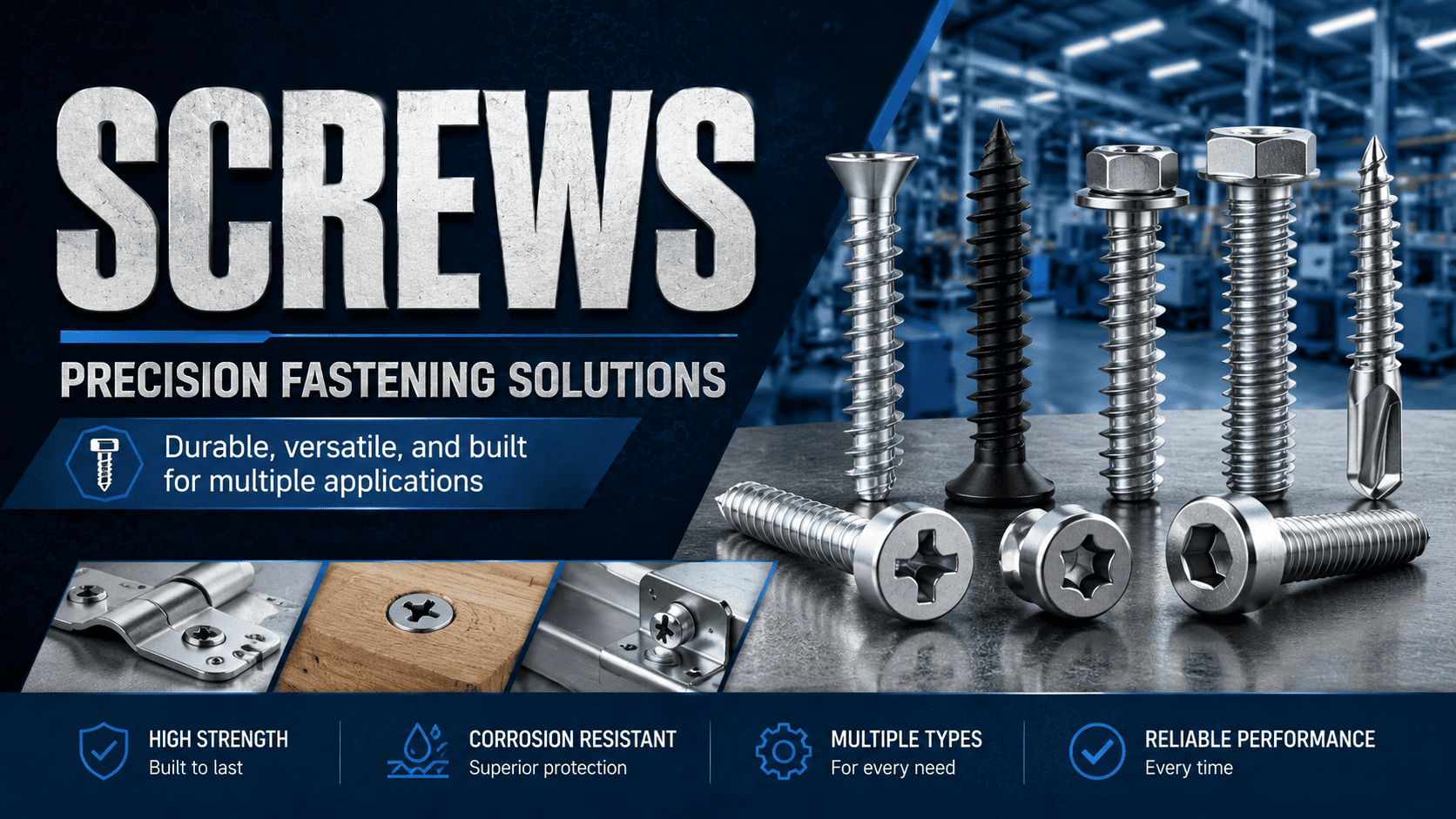
Common screw types include machine screws, self-tapping screws, self-drilling screws, wood screws, drywall screws, concrete screws, sheet metal screws, socket screws, and specialty screws. Each type is designed for a different material or fastening method. Using the wrong type may reduce holding strength, damage the workpiece, or create assembly problems later.
Choosing the correct screw improves fastening reliability, assembly efficiency, and long-term product safety. A screw that is too short may not hold properly, while one that is too long may damage the opposite side of the workpiece. In vibration or load-bearing applications, these mistakes become even more serious because the fastener is directly responsible for joint stability.
Industrial screws and construction screws often serve different priorities. Industrial screws usually require tighter tolerances, consistent mechanical properties, and compatibility with automated assembly. Construction screws more often emphasize site installation, holding power, corrosion resistance, and practical performance under field conditions.
Material selection also matters from the beginning. Screw material affects strength, corrosion resistance, weight, and cost. Carbon steel is common for general use, stainless steel is preferred where corrosion resistance matters, and specialty alloys are used for more demanding performance conditions. The right material should always match both load and environment.
Section Two: Screw Materials
Carbon steel screws are widely used because they are strong, affordable, and suitable for many general applications. They are often coated to improve corrosion resistance. However, untreated carbon steel may rust quickly in humid or outdoor environments, so it should not be selected for exposed conditions without the right surface treatment.
Stainless steel screws provide better corrosion resistance and are commonly used in outdoor, marine, food equipment, medical, and humid environments. They are also useful where appearance and durability matter. That said, stainless screws are not always the highest-strength option, so buyers should still confirm strength grade instead of assuming stainless automatically means stronger.
Zinc-coated screws use a protective surface layer to reduce corrosion and are common in construction, furniture, and general industrial applications. The coating type and thickness both affect long-term performance. In mild environments this may be sufficient, but in harsh outdoor or corrosive conditions, standard zinc coating may not last as long as needed.
Specialty alloy screws are used in aerospace, chemical environments, high-temperature equipment, electronics, and other demanding applications. These materials may offer heat resistance, chemical resistance, or special mechanical properties. They usually cost more, but they are necessary in environments where standard carbon or stainless screws are not enough.
Section Three: Common Applications
In the construction industry, screws are used in wood framing, drywall, roofing, metal framing, decking, concrete fixing, and structural assembly. They must match the base material and the load requirement. Outdoor construction work should also consider corrosion resistance, because environmental exposure can change fastener life significantly.
Furniture manufacturing uses screws in wood panels, metal frames, hinges, brackets, and modular furniture systems. In this field, appearance, thread holding strength, and ease of assembly are all important. For mass production, screws also need to support consistent assembly speed and minimize rework caused by dimensional variation.
Metal fabrication often uses machine screws, self-drilling screws, sheet metal screws, and structural fasteners. The screw must match material thickness, hole type, and load requirement. Self-drilling screws are especially useful when drilling and fastening need to be done in one step, which can improve speed in repetitive fabrication work.
Electronics assembly uses small screws with tight tolerances, where size precision, plating quality, anti-loosening features, and clean surfaces are all important. In electronics, even minor screw inconsistency can affect automation, assembly efficiency, or product fit. This is why screw quality in this field is often judged more by precision than by simple strength alone.
Section Four: Screw Selection
Thread type affects holding strength and compatibility. Coarse threads are often used for softer materials like wood, while fine threads may be used for metal or precision assembly. Self-tapping and self-drilling threads are designed to reduce installation steps, but they still need to match material thickness and application purpose. A thread that is wrong for the material can damage both the fastener and the workpiece.
Head style also influences performance. Common styles include pan head, flat head, hex head, socket head, countersunk head, and truss head. The selected head affects appearance, tool compatibility, torque transfer, and surface finish. In some assemblies the head mainly affects function, while in others it also changes the visual quality of the final product.
Screw length should provide enough engagement without damaging the material. If the screw is too short, it may loosen easily. If it is too long, it may protrude, split the workpiece, or interfere with nearby parts. For industrial use, the length should always be selected based on material thickness and required thread engagement rather than visual guesswork.
Corrosion resistance is essential in outdoor, marine, food, medical, chemical, and humid environments. Stainless steel, zinc coating, nickel plating, and specialty coatings may all be considered depending on the application. The correct choice should be guided by the environment first, because a screw that performs well indoors may fail very quickly outdoors.
Section Five: Installation Tips
Correct torque is important because it prevents both under-tightening and over-tightening. Under-tightened screws may loosen, while over-tightened screws may strip threads, deform washers, or damage the workpiece. In automated assembly lines, torque control tools are especially important because repeated inconsistency can quickly turn into quality problems.
Thread stripping can happen when the wrong screw is used, pilot holes are incorrect, or torque is too high. Once threads are damaged, fastening strength is reduced and rework may be required. Using the correct thread type, proper driver tool, and appropriate hole preparation helps prevent this issue before it starts.
Some screws require pilot holes, especially in hardwood, thick metal, plastic, or brittle materials. Pilot holes can reduce cracking, splitting, and installation resistance. Self-drilling screws may not require pre-drilling in some metal applications, but material thickness still matters, so it is not safe to assume one screw will work the same in all cases.
Screws used in machinery, vehicles, roofing, or vibration environments should be inspected regularly. Loose screws, corrosion, or damaged heads should be addressed early. Maintenance inspection is often overlooked, but it helps reduce failure risk and extends the life of the surrounding product or structure.
Section Six: Quality Standards
Manufacturing precision affects thread fit, head shape, tool engagement, and assembly consistency. Poorly manufactured screws may strip easily or fail during installation. For industrial buyers, evaluating dimensional consistency and supplier quality control is just as important as checking the basic product type.
Mechanical strength includes tensile strength, shear strength, hardness, and fatigue resistance. Structural and industrial applications require screws that meet specific strength requirements. Using low-strength screws in high-load applications may lead to failure even if the size appears correct on paper.
Surface treatment affects corrosion resistance, appearance, friction, and compatibility with the application. Zinc plating, black oxide, nickel plating, passivation, and special coatings all serve different needs. The correct surface finish depends on whether the priority is appearance, corrosion resistance, assembly behavior, or a combination of these factors.
Screws may be manufactured according to standards such as ISO, DIN, ANSI, JIS, or ASTM depending on the market and application. Standard compliance helps ensure compatibility and predictable performance. For export or industrial supply, meeting the correct standard is often a core purchasing requirement rather than an optional detail.
Section Seven: Industry Trends
Demand for high-strength screws is increasing in automotive, construction, machinery, renewable energy, and industrial equipment. Stronger fasteners support lighter, more efficient designs and higher-performance assemblies. As products become more optimized, fastener strength and consistency become more visible in engineering decisions.
Automated assembly is also changing screw requirements. Screws used in automated systems need consistent dimensions, stable feeding, and reliable drive performance. Poor screw quality can cause machine jams, misfeeds, and production downtime, which means fastener quality directly affects factory efficiency.
Sustainable coatings are receiving more attention as manufacturers look for lower environmental impact and safer surface treatment processes. This trend is especially relevant in export markets, where compliance and environmental requirements continue to become stricter over time.
Future screw manufacturing will likely focus on precision, automation compatibility, corrosion resistance, lightweight applications, and more sustainable materials and coatings. The screw market may seem mature, but performance expectations continue to rise as end products become more demanding.
Conclusion
Selecting the right screws depends on material, application, environment, and required strength. Matching fasteners with the correct installation method helps improve structural reliability.
For industrial buyers, screw quality should be evaluated not only by price but also by precision, coating, strength, and long-term supply stability. In many cases, fastener consistency is what keeps the larger product dependable.
FAQ
What are the common screw types?
Common types include machine screws, self-tapping screws, self-drilling screws, wood screws, sheet metal screws, and socket screws.
Which screw material is best?
It depends on the application. Carbon steel is common, stainless steel is corrosion-resistant, and specialty alloys are used for demanding environments.
How do I choose screw length?
Choose based on material thickness, required thread engagement, and whether the screw may protrude or damage the workpiece.
What is a self-drilling screw?
A self-drilling screw has a drill point that can drill and fasten in one operation, often used for metal applications.
Can stainless screws rust?
Stainless steel resists corrosion better than carbon steel, but it can still corrode under harsh conditions depending on grade and environment.
How do I prevent loose screws?
Use proper torque, suitable thread type, lock washers, thread-locking compounds, or anti-loosening designs where needed.