

Preface
Polycarbonate Roof Screws are specialized fasteners used to secure polycarbonate roofing sheets in applications such as pergolas, patios, greenhouses, skylights, carports, and industrial roofing systems. Because polycarbonate sheets expand, contract, and respond differently from metal or timber panels, choosing the correct screws and washers is essential for waterproofing, durability, and long-term roof performance.
A good roofing fixing system is not only about screw strength. It also depends on washer quality, corrosion resistance, screw length, drilling position, fastening pressure, expansion allowance, and regular maintenance. If the wrong fastener is used, the roof may suffer from cracking, water leakage, sheet movement, or premature corrosion.
Many buyers focus first on sheet thickness or panel style, but in real roofing work, the screw and washer system often determines whether the installation stays stable after months of rain, heat, and movement. A polycarbonate roof may look fine on the first day, yet still develop leaks or cracks later if the fasteners were chosen incorrectly or installed too tightly. That is why fastening details matter more than they seem.
Contents
Section One: What Are Polycarbonate Roof Screws?
Polycarbonate sheets are lightweight, impact-resistant, and flexible, but they also expand and contract with temperature changes. Standard screws may fix the sheet too tightly, causing stress around the hole and increasing the risk of cracks. Special roofing screws are designed to fasten the sheet while allowing better sealing and load distribution, which makes them more suitable for outdoor plastic roofing systems.
Roofing screws usually differ from standard screws in head strength, corrosion-resistant finish, and sealing washer design. Many roof screws also come with self-drilling tips, making installation faster on metal structures. Standard screws may not provide sufficient waterproof sealing or long-term outdoor durability, which can eventually lead to leaks, rust, or loose fasteners.
Polycarbonate roof screws are commonly used in patio roofing, pergolas, greenhouses, skylights, walkway covers, carports, garden structures, and industrial roof panels. The structure below the sheet may be timber, steel, aluminum, or another framing material, so the screw type should always match the substrate instead of being selected only by appearance.
Waterproof fastening is especially important because even a small leak around a screw hole can create long-term problems such as staining, trapped moisture, corrosion, mold, or sheet movement. In many roofing applications, the washer is almost as important as the screw itself. A good washer compresses properly, seals the hole, and remains flexible under outdoor exposure.
Section Two: Types of Polycarbonate Roof Screws
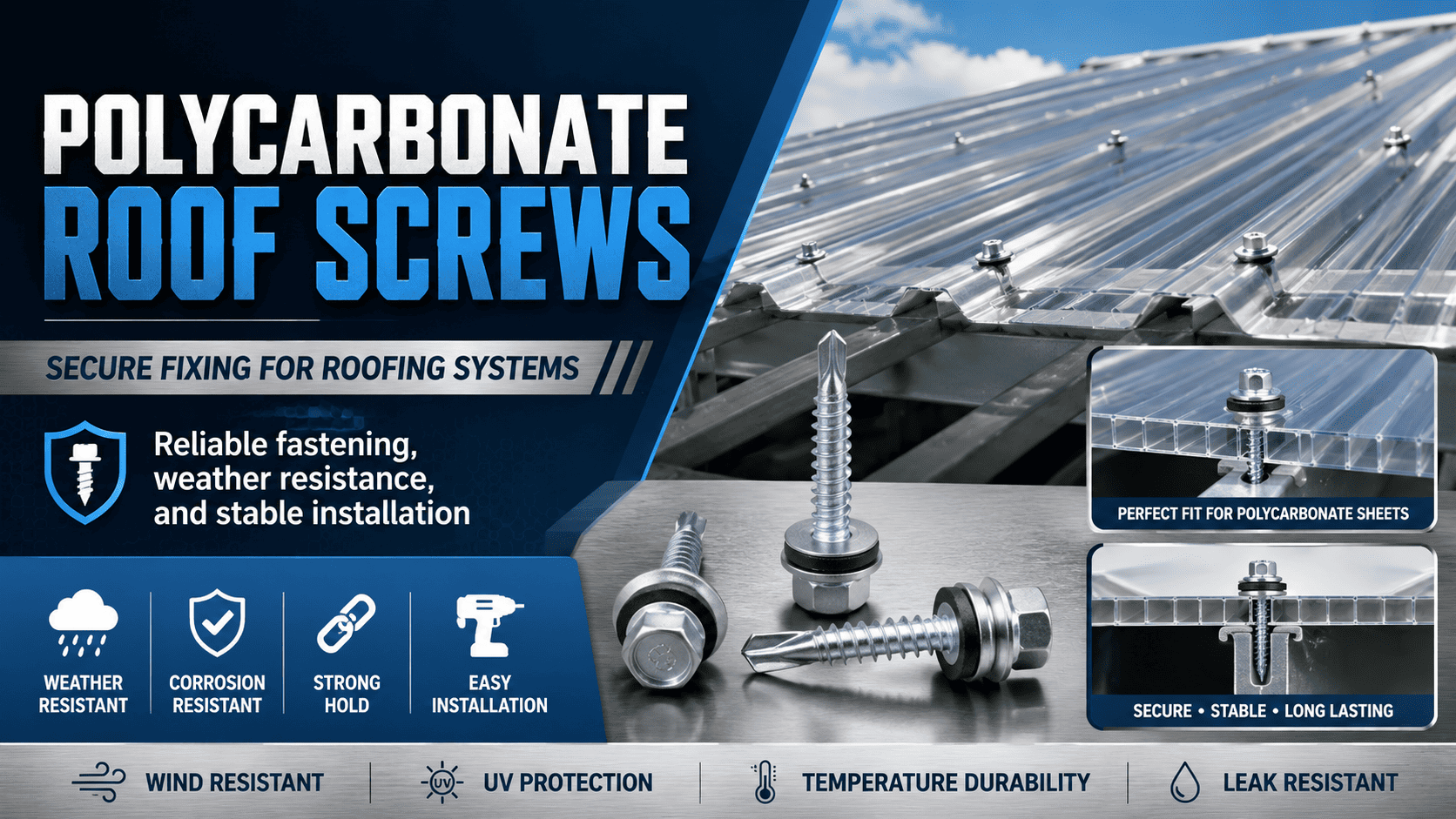
Self-drilling roof screws have drill points that can penetrate metal frames without pre-drilling in many applications. They are commonly used in steel roofing structures and industrial frames, which makes installation faster and more efficient. However, installers should still follow the sheet manufacturer’s recommendations, especially when polycarbonate expansion holes are required for movement control.
Hex head roofing screws are popular because they are easy to drive with a socket tool and provide good torque control. They are common in roofing, cladding, and outdoor structural applications. Proper torque is very important here. If the screw is over-tightened, the washer may deform and the sheet may crack. If it is under-tightened, waterproofing and holding strength may both be reduced.
EPDM washer roofing screws are widely used because the washer helps create a weather-resistant seal around the screw hole. EPDM washers are flexible, durable, and suitable for outdoor exposure when properly specified. Still, washer quality should not be ignored, because low-quality washers may harden, crack, or lose sealing ability after long exposure to sun and rain.
Stainless steel roofing screws are often selected where corrosion resistance matters, such as coastal areas, humid environments, greenhouses, or long-term outdoor roofing. They usually cost more, but they can reduce rust-related maintenance problems. Even then, stainless fasteners should still be selected according to the correct grade and the actual environment, because not all stainless materials perform the same way.
Section Three: Common Applications
Pergolas and patios often use polycarbonate sheets because they allow natural light while still providing rain protection. In these residential applications, the screws must secure the sheets against wind uplift while preventing water leakage. Appearance also matters, so fasteners should be neat, evenly spaced, and compatible with the overall roof structure.
Greenhouses require fasteners that can handle humidity, temperature variation, and frequent condensation. Corrosion-resistant screws and good sealing washers are especially important in these spaces. If fasteners rust or washers degrade, leaks and panel movement may occur, and that can affect the greenhouse environment as well as long-term maintenance cost.
Skylight installation requires careful sealing because water leakage can directly affect indoor ceilings, finishes, and structure. In this type of application, fastener placement, washer quality, flashing, and sealing details all need attention. Polycarbonate skylights should never be fixed too tightly, because thermal expansion and contraction may stress the panel over time.
Industrial roofing systems may face stronger wind loads, larger spans, and more demanding maintenance conditions. In those cases, screw strength, corrosion resistance, and installation consistency become critical. Fastener selection should follow the structural and roofing system requirements rather than only cost, because failures at this scale can become much more expensive later.
Section Four: How to Choose the Right Screw
Screw length should be long enough to pass through the polycarbonate sheet and secure firmly into the supporting structure. If the screw is too short, pull-out resistance may be poor. If it is too long, it may damage the substrate or make installation awkward. The correct length depends on sheet thickness, washer thickness, frame material, and required embedment depth.
Washer quality has a direct effect on waterproof performance. A high-quality washer should compress evenly, resist UV exposure, and maintain elasticity over time. It should not be flattened too much during installation. If the washer is over-compressed, it may lose sealing ability and even create stress on the sheet surface.
Corrosion resistance is another key factor in outdoor roofing. Roofing screws may be zinc-coated, coated carbon steel, or stainless steel depending on the environment. Humid, coastal, agricultural, or industrial settings usually demand better corrosion protection. A low-cost screw may look acceptable at first, but rust quickly if it is used in the wrong environment.
Wind-load performance should also be considered. Roofing fasteners must resist uplift and vibration, especially in exposed areas. Screw spacing, substrate strength, sheet profile, and roof exposure all affect performance. In high-wind areas, installers should follow roof system recommendations carefully instead of reducing the number of fasteners to save time or cost.
Section Five: Installation Tips
Fasteners should be positioned according to the roofing sheet manufacturer’s guidelines. Incorrect placement near sheet edges or unsupported areas can increase cracking and leakage risk. For corrugated sheets, screws are often installed at recommended crest or profile positions depending on the system design. This detail may look small, but it directly affects waterproofing and structural behavior.
To prevent sheet cracking, holes may need to be slightly larger than the screw diameter to allow thermal expansion. The screw should not clamp the sheet too tightly. Using sharp tools, proper drilling speed, and correct hole size helps reduce stress around the fastener. Many cracking problems are not caused by the sheet quality itself, but by installation pressure and hole preparation.
Polycarbonate expands and contracts with temperature changes, so installation must allow movement. If sheets are fixed too rigidly, stress may build up and cause buckling or cracks. Expansion allowance should be considered not only at screw holes, but also at overlaps, edges, and connection details. A roof that cannot move slightly is more likely to fail later.
Waterproof sealing depends on EPDM washers, correct torque, proper screw placement, and compatible flashing or sealant where needed. Sealants should be selected carefully because some chemicals may not be compatible with polycarbonate. A good installation is not about making everything as tight as possible. It is about balancing sealing pressure with movement allowance.
Section Six: Maintenance
Roof screws should be inspected periodically, especially after storms, strong winds, or long exposure to heat and rain. Loose screws, cracked washers, rust, or sheet movement should be addressed early. Regular inspection helps prevent small leaks from turning into major roof issues that affect the structure below.
Washers may age, harden, crack, or lose elasticity over time. If washers are damaged, they should be replaced before leaks occur. When replacing washers, installers should also check whether the screw hole has enlarged or the sheet has already cracked. Replacing only the washer without checking the surrounding condition may not fully solve the problem.
Corrosion prevention starts with choosing the correct screw material in the first place. Maintenance also includes removing debris, reducing trapped moisture, and replacing rusty fasteners when needed. Corroded screws can stain the roof surface and reduce holding strength, especially in environments with constant humidity or airborne salts.
The overall roof lifespan can be extended by using quality fasteners, correct installation spacing, compatible washers, proper cleaning, and timely maintenance. Even high-quality roofing sheets can fail earlier if the fastening system is ignored. In practice, many long-term roofing problems begin around the fixings, not the sheet body.
Section Seven: Industry Trends
Roofing systems are increasingly designed for durability, energy efficiency, and weather resistance. As roofing materials improve, fastener quality becomes more important because the connection points must support the performance of the whole system. Buyers are paying more attention not only to panels, but also to the small components that keep them secure.
Demand for stainless fasteners is increasing in environments where corrosion resistance matters. Although the cost is higher, stainless screws may reduce long-term replacement needs and maintenance frequency. For many commercial or exposed roofing projects, better fastener durability can justify the extra upfront cost.
Polycarbonate roofing is sometimes used around solar-related structures, skylights, and energy-conscious building designs. In these projects, fastening systems must support durability while avoiding leaks and structural issues. This means installers and buyers are placing more value on correct system compatibility rather than generic hardware selection.
Future fastening technology will likely focus on improved washers, better corrosion-resistant coatings, easier installation, and fastening systems designed specifically for plastic roofing sheets. As materials become more specialized, the supporting fasteners will also become more application-specific instead of relying on general-purpose screw options.
Conclusion
Choosing the correct Polycarbonate Roof Screws improves waterproof performance, durability, and roof safety. Proper installation and quality fasteners also help reduce long-term maintenance costs.
The best screw is not only the strongest one. It must match the sheet, frame, weather exposure, washer requirements, and installation method. When those factors are considered together, the roofing system is much more likely to stay stable over time.
FAQ
What are Polycarbonate Roof Screws?
They are roofing fasteners designed to secure polycarbonate sheets while helping prevent water leakage and sheet damage.
How long should roof screws be?
The screw length should match sheet thickness, washer thickness, and the supporting frame material.
Why are EPDM washers important?
EPDM washers help seal screw holes and reduce water leakage around fasteners.
Can stainless screws prevent rust?
Stainless screws provide better corrosion resistance, especially in humid or coastal environments, but the correct grade still matters.
How far apart should roof screws be?
Spacing depends on sheet type, roof design, wind exposure, and manufacturer recommendations.
Can roof screws be reused?
Reusing roof screws is usually not recommended if washers are damaged, threads are worn, or corrosion is present.