

Preface
A Facial Tissue Packing Machine is used to package folded facial tissues into soft packs, boxes, or customized retail packaging formats. For tissue manufacturers, OEM suppliers, private label factories, and export-oriented production lines, packing equipment plays an important role in improving packaging consistency, reducing labor dependency, and increasing production efficiency.
Choosing the right tissue packaging machine is not only about machine speed. Manufacturers also need to consider tissue size, folding format, packaging material, sealing quality, automation level, production line integration, machine stability, operator training, and after-sales service.
Many buyers first compare output speed or machine price, but in real tissue production, long-term value usually comes from packaging stability, easy adjustment, maintenance convenience, and whether the machine can connect smoothly with the rest of the production line. In other words, a facial tissue packing machine is not just a wrapping device. It is a key part of the whole converting and packaging workflow.
Contents
Section One: What Is a Facial Tissue Packing Machine?
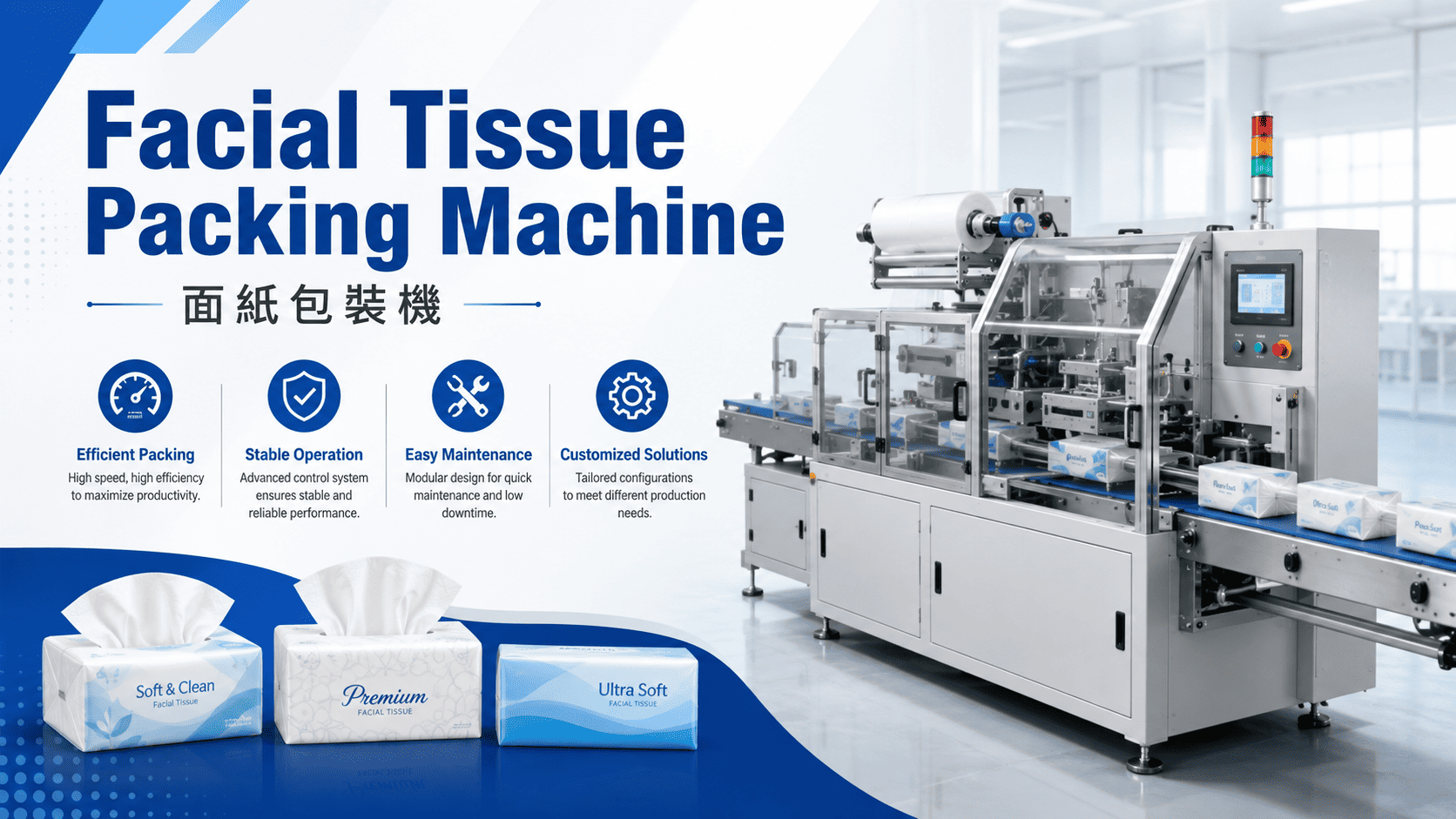
A facial tissue packing machine usually receives folded tissue stacks from the upstream process, positions the tissue, wraps it with film or inserts it into packaging, seals the pack, cuts the material, and discharges the finished product. Depending on the configuration, it may also connect with counting, stacking, cartoning, labeling, or case packing systems. This makes the machine much more than a simple sealing device.
The main goal is to keep each pack consistent in size, sealing, appearance, and output speed. For commercial tissue production, this consistency is essential for retail presentation and logistics. A pack that looks uneven or seals poorly may create quality complaints even when the tissue itself is acceptable.
Automated packaging reduces manual labor, improves packing speed, and lowers the risk of inconsistent pack appearance. Manual packaging may be suitable for very small batches, but it becomes inefficient when order volume increases. Automation also helps reduce unnecessary handling, which can support better hygiene and production control.
Manufacturers that need this equipment include household tissue factories, OEM and private label tissue suppliers, hotel-use tissue manufacturers, retail tissue brands, paper converting factories, and export-oriented tissue producers. If a factory produces large quantities of tissue products every day, automated packing equipment can significantly improve overall efficiency and output stability.
Section Two: Common Types of Tissue Packing Machines
Soft pack facial tissue packing machines are designed to wrap folded tissue stacks with flexible packaging film. They are commonly used for household facial tissue, portable tissue packs, and retail soft packs. In this type of machine, sealing quality, accurate cutting, neat appearance, and stable feeding are all critical, because packaging film performance directly affects the final result.
Box tissue packing machines are used for products packed in paper boxes or carton-style packaging. These machines may integrate tissue insertion, box forming, box closing, and output handling. Boxed tissue is often used in offices, hotels, restaurants, homes, and premium retail products, so the packaging machine must match both box size and tissue stack format.
Semi-automatic systems require more manual handling and are suitable for smaller factories, lower production volume, or flexible product formats. Fully automatic systems are better for high-volume production and stable specifications. Choosing between them depends on labor cost, budget, product consistency, and whether the factory expects future growth.
High-speed integrated production lines may connect folding machines, counting systems, packing machines, labeling, cartoning, and case packing equipment. These systems are suitable for larger manufacturers that need consistent output and reduced manual intervention. However, they also require more investment, stronger technical support, and better maintenance planning from the beginning.
Section Three: Main Applications
Household tissue manufacturing requires high output, stable packaging, and attractive retail presentation. Facial tissue packing machines help maintain consistent pack size and sealing quality. For household products, the outer pack matters a lot because consumers often judge quality from what they see before they ever open the package.
OEM and private label tissue production often requires more flexibility because different clients may need different tissue sizes, packaging designs, and pack counts. A good machine should support practical adjustment and stable repeat production. For OEM factories, fast changeover and reliable sealing are both important when managing multiple customer orders at the same time.
Commercial and hotel-use tissue packaging may include smaller packs, branded boxes, or bulk packaging formats. In these cases, packaging consistency still matters, but customization also becomes important. The right machine should allow the factory to balance speed with packaging variety, instead of forcing every customer into a single standard format.
Export-oriented tissue factories need packaging that meets overseas retail, logistics, and branding requirements. Machine stability, pack consistency, and material compatibility become especially important when orders are going to international buyers. For export operations, equipment reliability is not just a factory issue; it can directly affect shipment schedules and customer trust.
Section Four: How to Choose the Right Machine
Production capacity should match daily output requirements. A machine that is too slow can become a bottleneck, while a machine that is too large may increase unnecessary investment. Factories should calculate current production volume, peak demand, and future expansion before selecting packing speed. Choosing only by the biggest number is rarely the best decision.
Packaging format and material compatibility are also critical. Different machines support different formats such as soft packs, boxes, film wrap, or customized packaging. Film thickness, sealing temperature, cutting performance, and material tension all affect final packaging quality. The machine must fit the actual packaging design, not only the tissue dimensions.
Automation level should be selected based on factory size, labor availability, and operator skill. Higher automation can reduce labor requirements, but it also increases equipment cost and maintenance complexity. A fully automatic line may be ideal for large-volume production, while semi-automatic equipment may be enough for smaller or more flexible operations.
Machine stability and maintenance convenience should never be overlooked. Frequent downtime reduces output and increases repair cost. Buyers should consider machine structure, component quality, spare parts availability, and technical support. In long-term operation, easy maintenance often matters as much as production speed.
Section Five: Cost Factors
Machine speed and configuration strongly affect price. Higher-speed machines usually cost more because they require stronger structure, better control systems, and more precise components. Factories should avoid choosing speed only for presentation value. The real question is whether the machine matches actual production demand.
Custom packaging requirements may also increase machine cost. Special sealing methods, printed film, unusual box shapes, or multiple size formats may require extra design or adjustment. If customization is important for the business model, it should be discussed early instead of becoming a late-stage surprise.
Additional modules such as automatic feeding, counting, labeling, coding, inspection, cartoning, case packing, and conveyor systems can improve efficiency but will also increase investment. These modules should be evaluated based on return, not just technical attractiveness. More modules are not always better if they do not solve a real production problem.
Installation, training, and after-sales service should also be included in the total cost evaluation. A lower machine price may not be cost-effective if service support is weak or spare parts are difficult to obtain. For most buyers, the true cost of the machine is not just what is paid on delivery, but what it costs to keep the machine running smoothly later.
Section Six: Operation and Maintenance
Daily inspection should include checking film feeding, sealing temperature, cutting knives, sensors, air pressure, conveyor movement, and machine cleanliness. Regular cleaning helps prevent dust buildup and machine errors. A simple daily checklist can reduce unexpected downtime far more effectively than waiting until a fault appears.
Common sealing and cutting problems may come from incorrect temperature, film incompatibility, uneven pressure, worn sealing parts, dull blades, incorrect timing, or unstable material feeding. Instead of repeatedly adjusting the machine blindly, operators should identify the root cause. This saves both time and packaging waste.
Spare parts management is important for factories with continuous production. Essential parts such as blades, belts, sensors, heating elements, sealing parts, and pneumatic components should be prepared in advance. Waiting for spare parts during machine downtime can delay production and shipping schedules.
Machine service life can be extended through regular cleaning, correct operation, stable power supply, proper lubrication, timely replacement of wear parts, and operator training. A well-maintained machine will usually perform more consistently than a newer machine that is run carelessly without a maintenance plan.
Section Seven: Industry Trends
Tissue packaging machines are increasingly being integrated into smart factory systems. Data monitoring, production counting, fault alarms, and remote diagnostics can improve management visibility and reduce downtime. For larger factories, digital monitoring is becoming part of normal production control, not just an optional upgrade.
Sustainable packaging materials are also becoming more important. Brands are seeking recyclable, reduced-plastic, or more eco-friendly packaging options, which means machines may need to adapt to new film or paper-based materials. Compatibility testing will become more important in future machine selection.
High-speed automation demand will continue to grow as tissue consumption and private label production increase. Larger factories want to improve output and reduce labor costs, so integrated high-speed lines will remain attractive. However, flexibility and stable changeover will also become more valuable as packaging formats diversify.
Future tissue packaging technology will likely focus on higher speed, better flexibility, intelligent monitoring, energy efficiency, easier maintenance, and compatibility with sustainable packaging materials. Buyers will not only compare speed, but also how well a machine fits the factory’s long-term production model.
Conclusion
A Facial Tissue Packing Machine helps tissue manufacturers improve packaging consistency, reduce labor costs, and increase production efficiency. Choosing the right equipment requires evaluating output volume, packaging format, automation level, and long-term maintenance needs.
For tissue factories, the best machine is not always the fastest one. It should match product format, production scale, packaging requirements, operator capability, and future expansion plans. When the machine fits the real production environment, long-term efficiency is usually much better.
FAQ
What is a Facial Tissue Packing Machine?
It is a machine used to package folded facial tissues into soft packs, boxes, or customized packaging formats.
What types of tissue can it pack?
It can pack soft pack facial tissue, boxed tissue, travel tissue, commercial tissue, and private label tissue products.
How do I choose the right packing speed?
Choose based on daily output, upstream folding capacity, labor availability, and future production growth.
Can it be customized for different packaging sizes?
Yes, many machines can be customized or adjusted, but size range and changeover ability depend on machine design.
How often should the machine be maintained?
Daily inspection and regular maintenance are recommended. Frequency depends on production volume and operating conditions.
Can it be integrated into a full tissue production line?
Yes, it can be integrated with folding, counting, feeding, labeling, cartoning, and case packing systems.